A New Important Theme in Chriestian Art Is the Relationship Between the Hebrew Bible
Early Jewish and Christian Art
During the third and fourth centuries, Roman and Nearly Eastern Art influenced Jewish and Christian art.
- Depict the course, content, and context of key early on Jewish and Christian art
- Define key terms related to early Jewish and Christian art
- Distinguish between changes in formal stylistic elements, and religion-specific narrative content
- Explain the Roman influence on the origins of Christian art
Jewish Art
How is it that the Jews, called by Scripture "the smallest of all the nations" (Deut. 7:7) merit a section on religious architecture placed alongside the glories of Christendom, Islam, and Buddhism? Later on all, the Jews today number something around 14 million, the aforementioned number that existed before the massacre of half-dozen million in Europe and the dissolution of communities across Europe and the Arab world during the 1940s. This is a numerical highpoint. In previous centuries, the numbers were far smaller. But on the footing of demography, then, information technology would be hard to justify the inclusion of Judaism in this history of fine art and architecture.
A National Style?
More difficult, maybe, from the first century through the establishment of mod Israel in 1948 Jews could not claim (or assert, as new European nations states did) a "national" identity or a "national" style of art based upon landed nationalism—categories that were of key importance to nineteenth and twentieth-century constructions of architectural history and style. Theirs was a minority architecture, reflecting a minority being.
The Temple of Solomon (c. 900 BCE), modernistic scholars tell us, was a typical nearly-eastern temple, while the slap-up synagogues constructed at the plow of the twentieth century were art deco palaces. Fifty-fifty on a quality level, it is hard to include Jewish compages among the great religious architecture of the globe.

The greatest of Jewish edifice, the temples of Solomon (destroyed 586 BCE) and Herod in Jerusalem (destroyed seventy CE) are long gone, and never again have Jews controlled extensive resources for building, nor land for construction. There is no Jewish parallel to Saint Peter's (neither the "Old" one built by Constantine nor Julius Two's), nor Hagia Sophia, the temples of Varanasi, nor the Forbidden City. Pocket-size Jewish communities, stretched beyond the world from late-antique Palestine to Kaifeng in 17th century China to contemporary America and Israel congenital synagogues—often buildings of great dazzler and historical significance, but more often than not pretty express from an architectural standpoint. In that location were no Jewish benefactors to compete with Justinian or Saladin or the della Rovere; and virtually no government sponsorship of magnificent synagogues. Jewish architecture is always derivative of local styles and patterns and responds to the needs of local minority communities. Information technology never drove those styles. Jewish "architecture" through the ages was a hybrid compages—a term scorned by nineteenth and twentieth-century racial and national purists but celebrated in our own "post-modern" age.
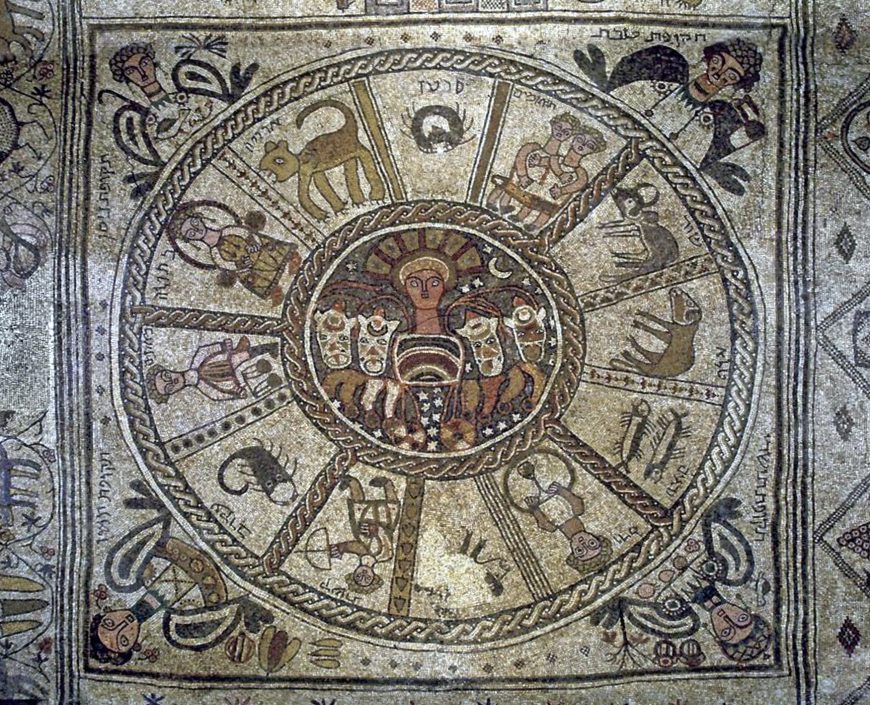
Longevity
What Jews lacked in territory, wealth and numbers, they fabricated up for in longevity. Jews—short for "the Judeans," trace their cultural heritage, and sometimes their physical lineage, to the biblical patriarchs—Abraham, Isaac and Jacob (also called State of israel) and to the land of Israel (called in Roman times Judaea)—an unbroken chain of 3000 years. This is not just an "imagined" history. No other western community tin assert—based upon rich documentary and physical evidence—to have encountered both Cyrus the Great and Innocent Three, Caligula and Mohammed, Victoria, Stalin and Rembrandt. Though a minority, Jews maintained rich mimetic traditions across the empires that brand up the "Western world," and an astonishingly complex volume culture that has sustained their sense of grouping cohesion. From antiquity to modern times, it was (and in many ways, however is) possible to travel from Jewish community to Jewish customs from Persia to Spain and beyond—as travellers did—and observe Jews who shared an all-encompassing religious civilization—even if they ate "strange" (though e'er kosher) foods, dressed "funny" (though males still wore the biblically mandated ritual "fringes") and adept "foreign" local liturgical customs. Not speaking the same vernacular linguistic communication, a company from, say, Germany might have communicated with his hosts in, say, Arab republic of egypt, by drawing upon a mix of "peculiarly pronounced" Hebrew and Aramaic gained through exposure to vast quantities of canonical religious texts.
Jews and their texts—not always together—have been active in what some textbooks notwithstanding telephone call "the Western Experience" from its outset. The religious traditions associated with Jesus and Mohammed both assert that Jewish scripture, and interaction with Jews, is essential to their own revelations, both of which assert relationship by virtue of having "superseded" the revelation of Moses. In other words, Jews "matter" to Christians and to Muslims, and by virtue of living among them, Christians and Muslims "mattered" to Jews.
The Study of Jewish Art and Architecture
The academic study of Jewish architecture developed from the eighteenth century onward, when Christian Hebraists and bible scholars developed interests in biblical compages—the Mosaic Tabernacle, the Solomonic Temple and the Herodian Temple—the latter visited by Jesus, who according to the Gospels predicted its destruction in lxx CE nether emperor Vespasian. Mail-"biblical" Jewish compages did non get a focus of research until discoveries past the Palestine Exploration Fund of late antiquarian synagogues during the 1860s. Medieval and early modern buildings took a bit longer to occasion scholarly interest. Jews in 19th century Europe, America and to some caste Islamic lands and south asia, were engaged in a total-scale building boom; the largest since Herod the Neat's rebuilding of the Jerusalem Temple beginning 20-xix BCE. Newly emancipated and emancipating communities asserted their presence by building huge synagogues, experimenting with a wide range of forms, from neo-Egyptian to neo-classical and neo-Moresque, eventually settling upon the modern nonetheless traditionalist tones of art deco.
Only at the finish of the 19th century did scholars begin to look back and report "Jewish art," including Jewish architecture; ofttimes looking—whether intentionally or non—for roots for the contemporary boom in earlier periods. Hoping to show that "Jews practice art too," Jews of all stripes hoped to bear witness their humanity through the creation and study of Jewish art. It was only in post-war New York that the first—and perhaps still the all-time—comprehensive surveys of Jewish religious architecture were written, both by art historian/builder Rachel Wischnitzer. These were entitledEuropean Synagogue Architecture andSynagogue Architecture in America. Past and then, the State of israel had been established, and "Jewish fine art"—including architecture—became the national art.
The canonical volume of this procedure was Cecil Roth'sJewish Fine art: An Illustrated History, first published in Hebrew in 1958 and still in print in Hebrew. This anthology brought together scholars who had been scattered throughout the world due to the War to present a comprehensive history, from Solomon to the nowadays. Architecture—until the modern period, all of it "religious" appears in every period and in almost every article, with some articles dedicated to this subject. The study of Jewish compages has been of detail interest to Israeli scholars, simply too to Americans and Europeans, and the Hebrew Academy'south Middle for Jewish Art has sent teams across the world to certificate historical synagogues—most no longer used. In Europe, this work takes on additional significance, equally information technology has been spawned by a real interest to regain a now-lost heritage—particularly in the East, as Europe, peculiarly since the fall of Communism, has sought to develop a more tolerant European tradition and usable history.
In recent years, Jewish visual culture has been deeply assimilated into the academic written report of Judaism, actually for the first time. Cultural historians, working with art historians and architectural historians, accept begun to focus upon the very elements of Jewish "minority" architecture that in previous generations were often spurned. The process by which a minor minority group melded with its full general environment, transforming and being transformed within that environment has get the stuff of gimmicky scholarship. In many ways, the Jews have been the "canary in the coal mine," the examination instance for theoretical discussion of what information technology means to live in a diaspora and to be Europe'southward first, earliest and about intimate—colonized people.
Early Christian Art
The beginnings of an identifiable Christian art can be traced to the finish of the 2nd century and the offset of the third century. Because the Old Testament prohibitions against , information technology is important to consider why Christian art adult in the first place. The apply of images will be a continuing issue in the history of Christianity. The best explanation for the emergence of Christian art in the early church is due to the important office images played in Greco-Roman civilisation.
As Christianity gained converts, these new Christians had been brought up on the value of images in their previous cultural experience and they wanted to continue this in their Christian experience. For instance, there was a change in burial practices in the Roman world away from cremation to inhumation. Outside the city walls of Rome, side by side to major roads, catacombs were dug into the ground to bury the expressionless. Families would take chambers or dug to coffin their members. Wealthy Romans would also have sarcophagi or marble tombs carved for their burial. Christian converts wanted the same things. Christian catacombs were dug ofttimes adjacent to non-Christian ones, and sarcophagi with Christian imagery were evidently popular with the richer Christians.
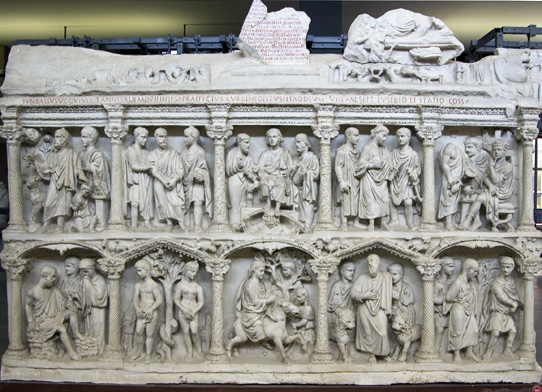
Junius Bassus, a Roman praefectus urbi, or high-ranking government ambassador, died in 359 CE. Scholars believe that he converted to Christianity soon before his death accounting for the inclusion of Christ and scenes from the Bible. (Photograph above shows a plaster bandage of the original.)
Themes of Death and Resurrection
A hit aspect of the Christian art of the third century is the absence of the imagery that will dominate later Christian art. We practise not notice in this early period images of the Nativity, Crucifixion, or Resurrection of Christ, for example. This absence of directly images of the life of Christ is all-time explained past the status of Christianity as a mystery religion. The story of the Crucifixion and Resurrection would be part of the secrets of the cult.
While not directly representing these fundamental Christian images, the theme of death and resurrection was represented through a series of images, many of which were derived from the Old Attestation that echoed the themes. For instance, the story of Jonah—being swallowed past a great fish then later on spending three days and three nights in the belly of the beast is vomited out on the dry ground—was seen by early Christians every bit apprehension or of the story of Christ'southward ain expiry and resurrection. Images of Jonah, forth with those of Daniel in the King of beasts's Den, the Iii Hebrews in the Fiery Furnace, Moses Striking the Rock, among others, are widely popular in the Christian art of the third century, both in paintings and on sarcophagi.
All of these can be seen to allegorically allude to the main narratives of the life of Christ. The common field of study of salvation echoes the major emphasis in the mystery religions on personal conservancy. The appearance of these subjects oft adjacent to each other in the catacombs and sarcophagi can be read as a visual litany: save me, Lord, equally y'all have saved Jonah from the belly of the great fish, salve me Lord every bit you take saved the Hebrews in the desert, save me Lord equally you have saved Daniel in the King of beasts'south den, etc.
I can imagine that early Christians—who were rallying effectually the nascent religious authority of the Church against the regular threats of persecution by majestic dominance—would discover great pregnant in the story of Moses of striking the stone to provide h2o for the Israelites fleeing the authorisation of the Pharaoh on their exodus to the Promised Land.
Christianity's Approved Texts and the New Attestation
One of the major differences between Christianity and the public cults was the central role faith plays in Christianity and the importance of orthodox behavior. The history of the early Church is marked by the struggle to establish a set of texts and the establishment of orthodox doctrine.
Questions about the nature of the Trinity and Christ would continue to challenge religious say-so. Within the borough cults, there were no central texts and there were no orthodox doctrinal positions. The emphasis was on maintaining customary traditions. One accustomed the existence of the gods, but there was no emphasis on belief in the gods.
The Christian emphasis on orthodox doctrine has its closest parallels in the Greek and Roman world to the role of philosophy. Schools of philosophy centred around the teachings or doctrines of a item teacher. The schools of philosophy proposed specific conceptions of reality. Ancient philosophy was influential in the formation of Christian theology. For example, the opening of the Gospel of John: "In the beginning was the word and the word was with God…," is unmistakably based on the idea of the "logos" going dorsum to the philosophy of Heraclitus (c. 535 – 475 BCE). Christian apologists like Justin Martyr writing in the 2nd century understood Christ every bit the Logos or the Word of God who served as an intermediary betwixt God and the World.
Early on Representations of Christ and the Apostles

An early on representation of Christ found in the Catacomb of Domitilla shows the effigy of Christ flanked by a grouping of his disciples or students. Those experienced with later Christian imagery might mistake this for an image of the Last Supper, but instead, this image does not tell any story. It conveys rather the thought that Christ is the true teacher.
Christ draped in classical garb holds a whorl in his left manus while his correct paw is outstretched in the so-calledad locutio gesture or the gesture of the orator. The dress, scroll, and gesture all establish the authorization of Christ, who is placed in the center of his disciples. Christ is thus treated like the philosopher surrounded by his students or disciples.
- Jews, like other early religious communities, were wary of art beingness used for idolatrous purposes. Over time, official interpretations of the Second Commandment began to disassociate religious art with graven images.
- Early Christian, or Paleochristian, art was produced by Christians or under Christian patronage from the earliest catamenia of Christianity to betwixt 260 and 525.
- The lack of surviving Christian art from the first century could be due to a lack of artists in the community, a lack of funds, or a pocket-size audience.
- Early Christians used the same artistic media equally the surrounding pagan culture. These media included frescos, mosaics, sculptures, and illuminated manuscripts.
- Early Christians used the Late Classical style and adapted Roman motifs and gave new meanings to what had been pagan symbols. Because the organized religion was illegal until 313, Christian artists felt compelled to disguise their bailiwick matter.
Adjusted from Dr. Steven Fine, "Writing a history of Jewish architecture," in Smarthistory , August 8th. https://smarthistory.org/writing-a-history-of-jewish-architecture/.License: Creative Commons Attribution-NonCommercial-ShareAlike four.0 International License
And from Dr. Allen Farber, "Early Christian art," in Smarthistory, August viii, 2015. https://smarthistory.org/early on-christian-fine art/. License: Creative Commons
Attribution-NonCommercial-ShareAlike iv.0 International License
Source: https://pressbooks.bccampus.ca/cavestocathedrals/part/christian-art/
0 Response to "A New Important Theme in Chriestian Art Is the Relationship Between the Hebrew Bible"
Enregistrer un commentaire